Somewhere around late 2024, “SEO is dead” turned into one of those phrases people repeat without checking if it’s still true. I hear it from clients constantly now: why write another blog post if Google just summarizes it and nobody clicks through?
Fair question. The honest answer is messier than yes or no.
What actually happens when an AI Overview shows up
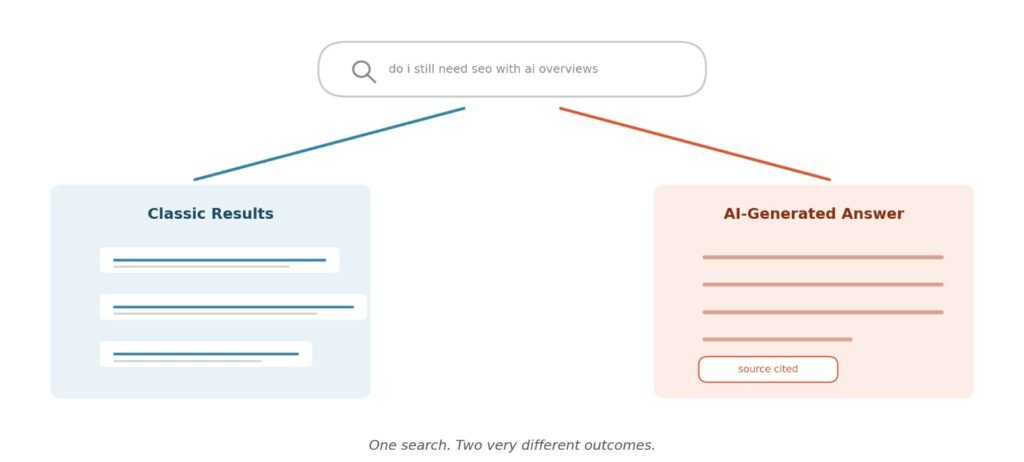
An AI Overview is the block of text Google generates at the top of the results page, above the traditional list of links, answering the query directly using content pulled from a handful of sources. As of March 2026 it’s showing up on roughly 48% of searches, and that share has grown fast over the past year.
When it appears, fewer people click anything below it. That part isn’t in dispute. What’s less settled is how much less, because the studies don’t all agree on the exact number, and the trend line has actually started bending in an unexpected direction.
The data: how much traffic AI search has actually taken
Here’s where I’d normally tell you to trust one big number. I can’t, because the research is genuinely split, and pretending otherwise would be dishonest.
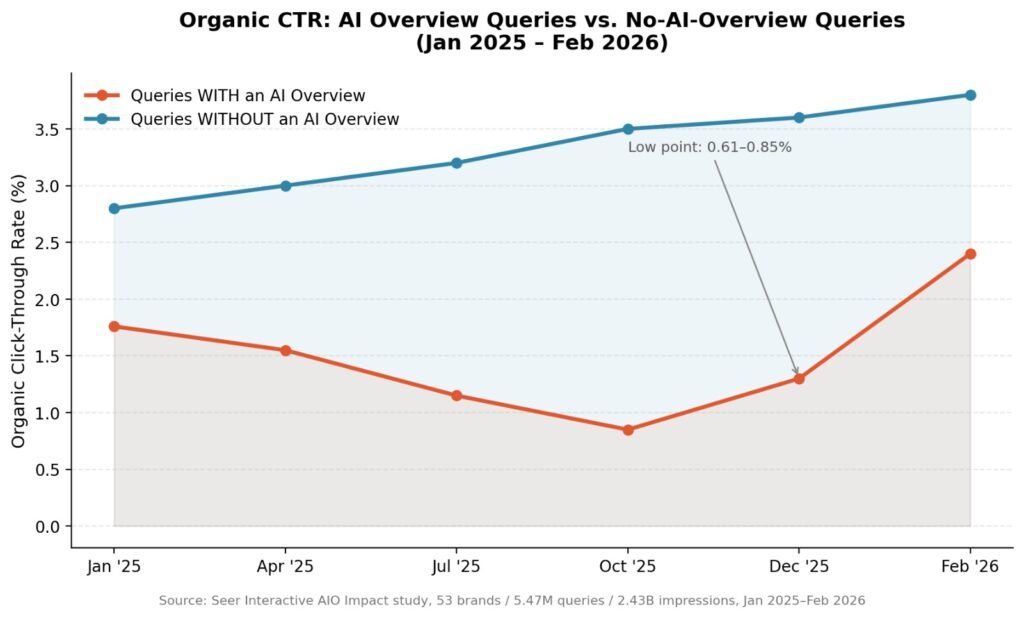
Seer Interactive tracked 53 brands across 5.47 million queries and 2.43 billion impressions from January 2025 through February 2026. Organic click-through rate on AI Overview queries fell sharply through most of 2025, bottomed out toward the end of the year, then climbed back up by February 2026. Queries with no AI Overview present moved the opposite direction, gaining click-through rate steadily over the same stretch.
Ahrefs, working from a separate sample of 300,000 keywords, found the top-ranking page loses about 58% of its clicks when an AI Overview appears. Pew Research’s panel study puts organic click rate at 8% with an AI Overview present versus 15% without one. A randomized field experiment published in early 2026, the first of its kind with real causal design rather than correlation, found AI Overviews cut outbound clicks by 38% on the queries where they triggered, and pushed the zero-click rate on those queries from 54% up to 72%.
Different methodologies, different exact figures. Same direction. Fewer clicks, more zero-click searches, and the drop is worst on queries that used to send the most traffic: single-fact lookups, definitions, quick comparisons.
AI Overviews vs. AI Mode: two very different threats
It’s worth separating two things people lump together. AI Overviews sit on top of normal search results, so the blue links are still there underneath. AI Mode replaces them entirely with a conversational interface, and it produces something closer to a 93% zero-click rate. If AI Mode becomes the default way people search, that’s a much bigger structural shift than AI Overviews have been so far. It’s not there yet. But it’s the one to watch.
Why “SEO is dead” is the wrong conclusion
Here’s the part that gets left out of most of these panic posts: AI Overviews and ChatGPT don’t generate answers from nowhere. They pull from indexed web content, mostly the same content that already ranks in classic search. Google has said publicly that AI Overview source selection favors pages already doing well in organic results. A cross-platform study found that roughly three-quarters of URLs cited in Google’s AI Overviews also rank in the top 10 organically for that query.
So the pages showing up inside AI Overviews are, overwhelmingly, pages that already had solid SEO. Stop doing SEO and you don’t just lose blue-link traffic, you lose your shot at the citation too. That’s the opposite of what “SEO is dead” implies.
Where the picture gets more complicated is ChatGPT, which runs on Bing’s index rather than Google’s. Its overlap with Google’s own top 10 is weaker, somewhere around 12 to 25% depending on whose study you read. Ranking well on Google is a strong hint but not a guarantee you’ll get picked by ChatGPT.
SEO didn’t disappear, it split into two jobs
I think this is the useful reframe. Ten years ago SEO had one job: rank in the ten blue links, get the click. Now it has two, and they don’t fully overlap.
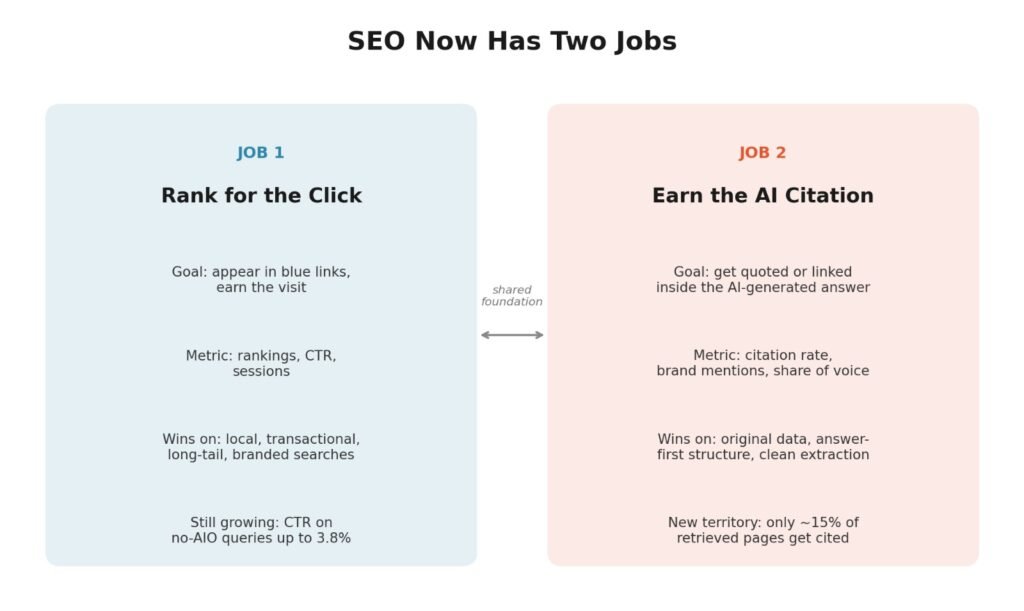
Job 1: still ranking in classic blue links. Plenty of queries still show no AI Overview at all, especially local, transactional, and highly specific long-tail searches. Those queries increased their own click-through rate over the same period AI Overview queries were losing clicks. Traditional ranking still pays off there, arguably more than before, because the users clicking through are the ones who actually want to leave Google.
Job 2: getting cited inside the AI answer. This is newer territory, usually called AEO (answer engine optimization) or GEO (generative engine optimization). The goal isn’t the click, it’s the citation, the mention, the moment your brand name appears inside someone’s ChatGPT answer even if they never visit your site. That still builds awareness and trust, even without a session showing up in your analytics.
Both jobs draw on the same foundation: solid technical SEO, genuine expertise, clear writing, real structure. But the content decisions diverge. A page built purely to rank number one for a competitive keyword and a page built to be lifted cleanly into an AI-generated answer aren’t always the same page.
How AI systems actually pick what to cite
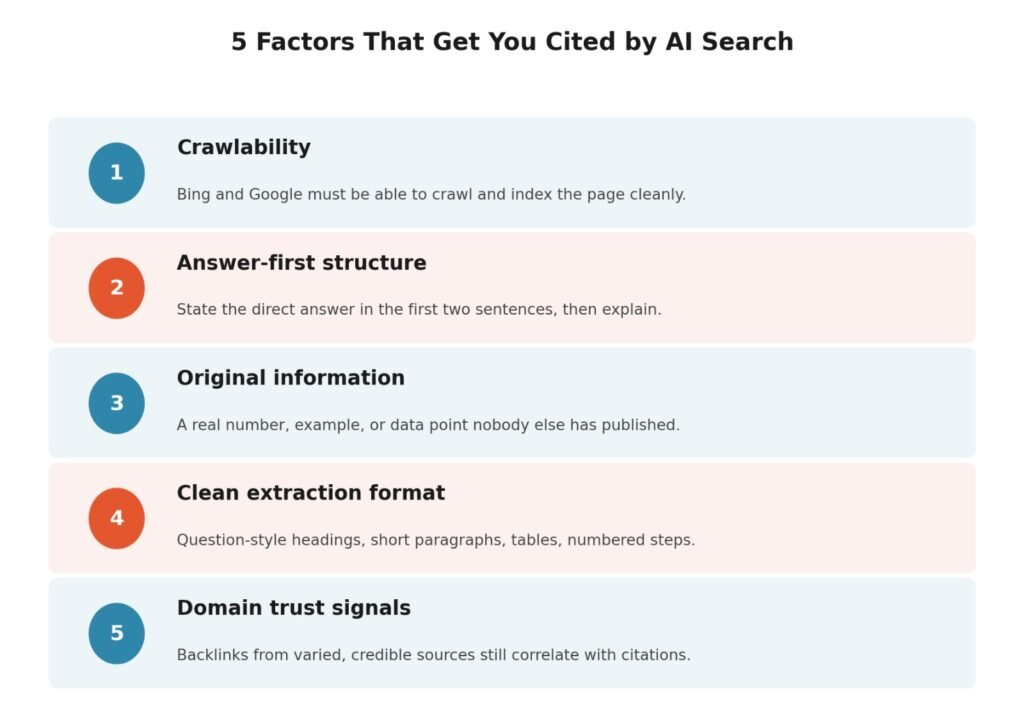
An AirOps study that analyzed over half a million pages across 15,000 prompts found ChatGPT actually cites only about 15% of the pages it retrieves as candidates. Getting pulled into the pool isn’t the hard part. Getting picked out of it is.
None of that is exotic. It’s mostly good SEO with an extra layer of formatting discipline on top.
What to do differently starting now
I’d rather give you four concrete moves than a vague call to “adapt.”
- Audit which of your money queries even trigger an AI Overview. Not every keyword does. Spend your energy where the overview is actually showing up, and don’t assume short or broad terms are exempt. Even single-word queries trigger an overview more than a quarter of the time.
- Rewrite your top pages so the answer appears in the first two sentences. Save the nuance and the story for after. Models extract the front of the page far more reliably than the middle.
- Add something that isn’t already on the internet. A number from your own data, a client result, a process you actually use. This is the single biggest lever in every study out there, and it’s the one most content teams skip because it takes real work.
- Check your indexing on Bing, not just Google. If ChatGPT can’t find you because you never verified Bing Webmaster Tools, you’ve left citations on the table for a five-minute fix.
Who can safely ignore most of this
If your business runs on local search, on branded search, or on queries that rarely trigger an AI Overview in the first place, the shift matters less to you right now. Check your own Search Console data before assuming you’re in the blast radius. A lot of the loudest “SEO is dead” posts are written by people in broad informational content, the segment hit hardest, and generalized to everyone else.
The bottom line
AI Overviews took a real bite out of click-through rates, somewhere between a third and two-thirds depending on the query and the study. That’s not nothing. But the sites losing the most are usually the ones that were already thin on original value, the kind of content built to rank rather than built to actually help someone. If your SEO strategy was already grounded in genuine expertise and clear structure, you’re better positioned for this shift than the headlines suggest, not because SEO stayed the same, but because it grew a second job.
Frequently Asked Questions
Is SEO dead because of ChatGPT and AI Overviews?
No. Most sources cited inside AI Overviews and ChatGPT answers already rank well in traditional search. SEO fundamentals still decide who gets considered; the difference is that being considered no longer guarantees a click.
What’s the difference between SEO, AEO, and GEO?
SEO optimizes for ranking in traditional search results and earning the click. AEO (answer engine optimization) and GEO (generative engine optimization) optimize for being cited or quoted inside an AI-generated answer, whether or not the user ever clicks through.
Do AI Overviews really reduce website traffic?
Yes, on the queries where they appear. Studies put the click-through rate drop between roughly 34% and 61% depending on methodology, with some recovery showing up in early 2026 data.
Should I stop writing blog content because of AI search?
No, but generic, rehashed content is the least valuable format right now. Content with original data, direct answers, and clean structure is what AI systems actually lift into their responses.
Does ranking well on Google guarantee I’ll be cited by ChatGPT?
Not guaranteed, but it helps. ChatGPT runs primarily on Bing’s index, so the overlap with Google’s top 10 is real but weaker, estimated between roughly 12% and 25% in different studies.
Author: Meet Shah – Founder, Webyvibz